
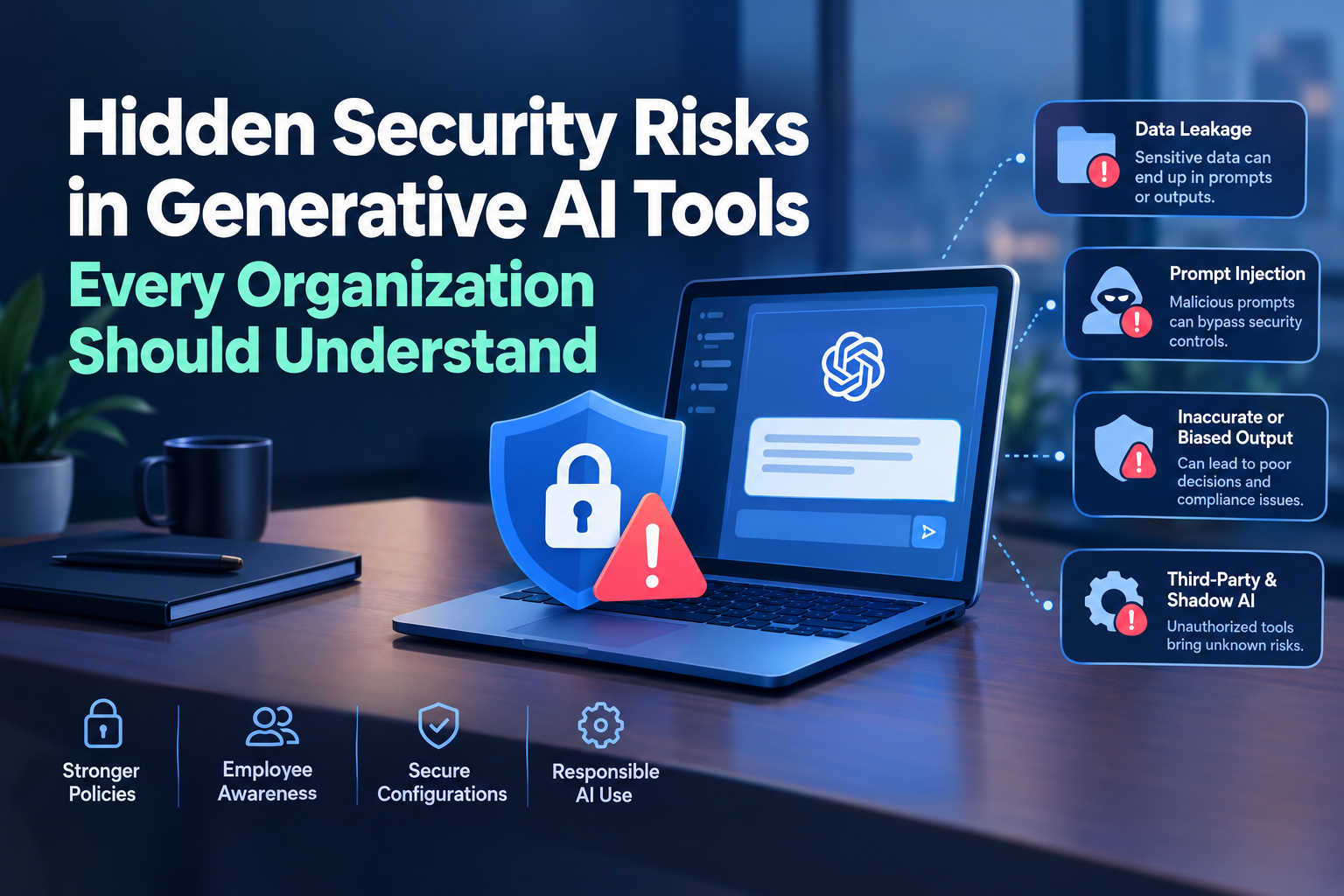
Generative AI tools reach organizations through a front door that security teams recognize and a dozen side doors they do not. A chatbot in a browser tab is easy to see. An assistant built into an office suite, a coding helper in an editor, a plugin that connects a model to the CRM, and an agent that reads inbound email are harder to track, and each carries its own exposure.
For security and IT leaders, the task is to understand the risks well enough to make sensible decisions about adoption, not to stop it. The sections below cover why these risks are easy to miss, how data exposure and known weaknesses in popular tools behave, how prompt injection works, what plugin and integration risks add, and which governance steps give leaders control without freezing useful work.
Why the Risks Are Easy to Overlook
Generative AI feels like conversation, and conversation feels private. A user types a question, reads an answer, and moves on. Nothing resembles uploading a file to a vendor or granting a third party access to a database, even though both may be happening behind the scenes.
Traditional security assumptions also fit poorly. Software has defined inputs and outputs, and its behavior can be tested and repeated. Language models behave probabilistically, can respond differently to the same prompt, and accept instructions written in plain language. Controls that depend on predictable behavior, such as input validation and fixed permission checks, do not map neatly onto them.
Speed adds to the difficulty. New features, model versions, and integrations arrive frequently, and business units adopt them without waiting for review. A tool approved in January may have a different data handling policy, new connectors, or a new capability by summer.
Finally, benefits are tangible and risks are abstract. Employees see time saved immediately, while the cost of a leaked document may never be traced back to a chat window. Leaders who want realistic governance need to make the risks concrete, using examples and clear descriptions of what could go wrong in their own environment.
Data Exposure and ChatGPT Vulnerabilities
Data exposure comes in several forms. The most direct is user input: staff paste confidential material into a tool whose retention and training policies they have not read. Another form is stored history, since conversations and uploaded files may remain in an account for long periods and become targets if the account is compromised. A third is provider-side failure, where a flaw in the service exposes data belonging to others.
The last category has occurred in public. OpenAI reported in March 2023 that a bug in an open-source library caused some users to see titles from other users’ conversations, and that a small number of subscribers had limited billing details exposed. Reported ChatGPT vulnerabilities and those in similar services have also included issues in connected components, authentication flows, and sharing features that made conversations more visible than users expected. Security researchers continue to publish findings of this type across the industry.
Leaders should treat ChatGPT vulnerabilities, and those in comparable tools, as a class of third-party risk instead of one-off events. Ask providers about their security testing, bug bounty programs, incident disclosure practices, data isolation between customers, and encryption in transit and at rest. Review independent audits and certifications where available.
Shared links and public sharing features deserve attention too. Conversations shared through a link may be indexed or forwarded, and the person who created the link may not know where it ends up. Policy should address whether sharing is allowed and how links are managed.
Prompt Injection and Model Manipulation
Prompt injection exploits a basic property of language models: instructions and data arrive in the same channel, and the model cannot always tell them apart. A malicious instruction placed in a web page, a PDF, a calendar invite, or an email can steer a model that processes that content.
Two forms are commonly described. In direct injection, a user types instructions intended to override the system’s rules, often called jailbreaking. In indirect injection, the attacker plants instructions in content the model will later read. The second form is more dangerous in business settings, because the victim never sees the malicious text and the attacker does not need access to the tool.
The impact depends on what the system can do. A model that only produces text can mislead a reader. A model connected to tools can send messages, query databases, fetch URLs, or modify files. In some demonstrated cases, researchers have shown assistants being tricked into leaking data by encoding it into a link or an image request that the attacker controls.
Related threats include training data poisoning, where manipulated source material shapes model behavior, and model extraction, where repeated queries are used to reproduce a proprietary model. Output risks also matter. Models can produce confident but false statements, insecure code, or fabricated references, and downstream systems that trust the output without checking will inherit those flaws.
Plugin, Connector, and Supply Chain Risks
Integrations expand what generative AI can do, and they expand what can go wrong. Plugins, connectors, and agents often hold access tokens to email, storage, calendars, ticketing systems, and code repositories. A permission granted for convenience may allow far more than the task requires, and a compromised plugin can act with the user’s authority.
Third-party extensions raise supply chain questions. Who built the plugin, how is it maintained, what data does it collect, and where does that data go? Marketplaces may review submissions unevenly, and a trusted extension can change ownership or be updated with harmful code. Browser extensions that claim to add AI features have been used to harvest data, which makes extension inventories a worthwhile control.
Open-source models and libraries add another layer. Downloaded model files can contain malicious code if loaded in unsafe formats, and dependencies in AI frameworks follow the same vulnerability cycle as any other software. Development teams that build internal applications on top of models should apply normal secure development practices, including dependency scanning and secrets management.
Agents deserve their own caution. When an AI system can plan and take actions across tools, a single injected instruction can cascade. Limiting scope, requiring approval for sensitive steps, and logging every action keep that power in check.
Governance Steps for Security and IT Leaders
A workable governance program does not need to be elaborate. The following steps cover most of the ground:
- Inventory AI tools, extensions, and integrations in use, sanctioned or not
- Classify data and define which categories may enter which tools
- Assess vendors for data handling, retention, training use, and incident response
- Require single sign-on, multi-factor authentication, and role-based access for approved tools
- Restrict plugin and connector permissions to the minimum needed
- Add human approval for actions that send data or change records
- Log prompts, outputs, and tool calls where privacy rules permit
- Test applications for prompt injection and unsafe output before release
- Train employees with concrete examples and an easy path to ask questions
Ownership should be explicit. A named lead, supported by security, legal, privacy, and business representatives, can review requests and update guidance. Metrics help keep the effort honest: number of approved tools, share of usage on sanctioned platforms, incidents involving AI, and time to evaluate a new request.
Review cycles should be short. Revisit vendor terms and risk ratings at least twice a year, and sooner after a significant product change or public incident.
Final Analysis
Generative AI introduces risks that are real but manageable once they are described plainly. Data can leave through ordinary use, tools can have flaws like any software, prompts can carry hidden instructions, and integrations can widen the reach of a single mistake.
Leaders who combine visibility, vendor scrutiny, limited permissions, human approval for sensitive actions, and practical training place themselves in a position to benefit from the technology while keeping control of the information it touches. Governance that evolves as quickly as the tools is the strongest protection available.
A sensible next step is a short risk review of the three AI tools used most widely inside the organization. Document what data each touches, what permissions it holds, and who owns it. That small exercise usually exposes the largest gaps and gives leaders a factual basis for the broader program.